TRACE: a framework for critical engagement with text
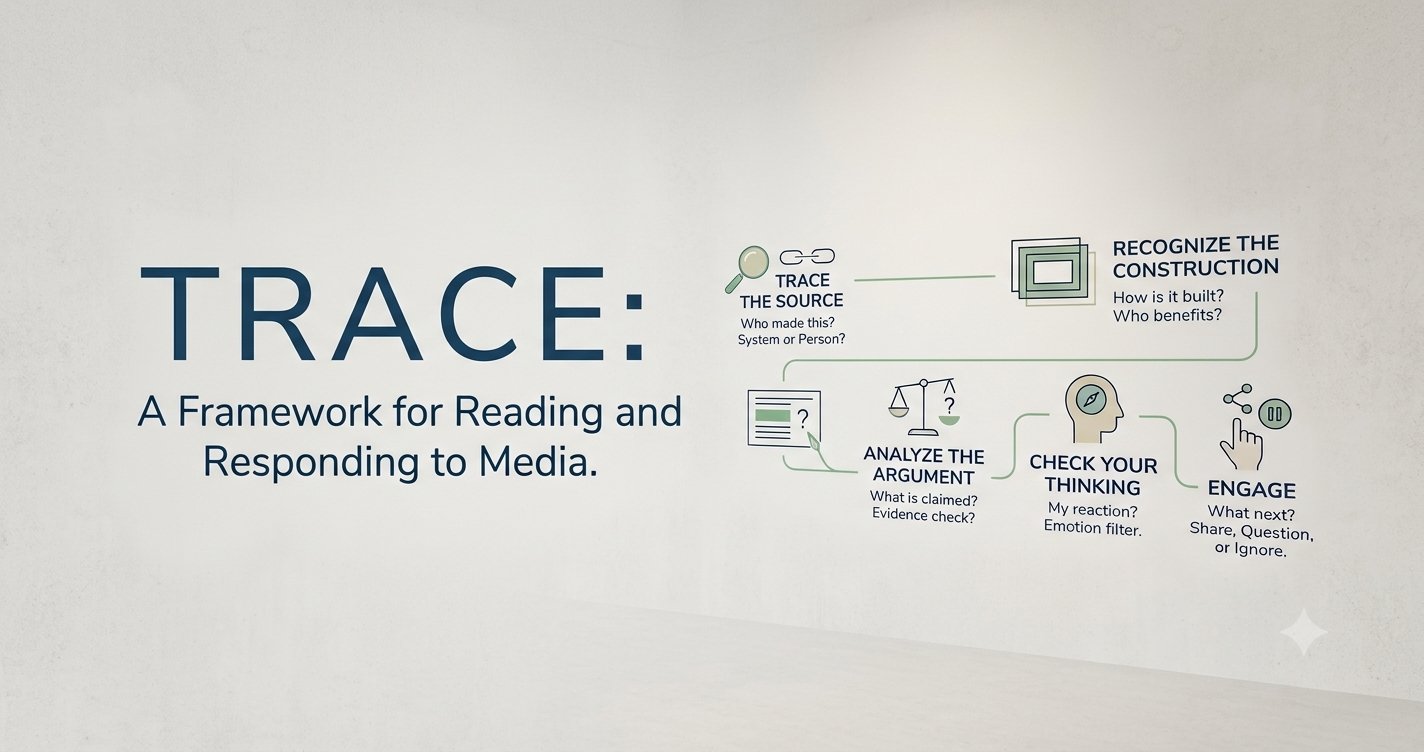
I have spent most of my working life teaching people to ask one question before they believe, share, or act on anything: who made this, and why. I asked that question in classrooms in Iran, long before generative AI existed, while teaching academic writing and literary translation. I asked it again as a doctoral researcher studying argumentation theory in the Netherlands. I am still asking it now, in Oslo, except the answer has become harder to find, and the things I am asking it about are no longer only paragraphs. They are omnipresent photographs, ads, memes, and chatbot replies too.
A chatbot can now write a paragraph that sounds more confident than most human writing. It can invent a citation that looks exactly like a real one. It can name a real author and attach a book that was never written. In 2025, a major American newspaper printed a summer reading list built this way. Ten of the fifteen books on it did not exist. The prose was so professional that no editor caught it before the list went to print. I think about that story often. It captures something I had already been noticing for years in my students’ work: fluency is not accuracy, and confidence is not truth.
In my own work I use the word text broadly. Not just paragraphs, but any record someone built on purpose to mean something: a photograph, an advertisement, a chart, a video, a meme, a chatbot’s answer. The habits we used to teach were built for one kind of text, a written page, and they came apart the moment images, video, and AI-generated replies became just as easy to fabricate as a paragraph.
For a long time, teachers, myself included, taught a few surface signals before trusting a source. Look for a named author. Check the domain. Notice whether the page looks professionally built. Those signals worked reasonably well when producing something polished took real time, real editing, and real expertise, whether the thing being produced was an article or an image. A generative system removes all three requirements at once. It can produce a fabricated source, a convincing photograph, and a well-designed page in the same breath as a genuine one, and nothing on the surface gives it away.
The tools I had spent years teaching needed to widen their scope, and they needed to stop stopping at the moment of understanding (something like the SIFT framework). Making sense of a text is only half the job. What a person does next with that understanding, share it, question it, repeat it, ignore it, i.e., (dis)engagement is the other half, and most frameworks I had used barely touched it. So I built something of my own. Not a new philosophy of media literacy, but five habits a person could actually run through in their head in under a minute, for any text, in any medium. I called it TRACE.
TRACE has five parts, and they build on each other. Trace the source asks who made this and what they want from you, whether that is a person, an institution, or a system trained on someone else’s work. Recognize the construction asks how the text was put together: how a photo was cropped, how an ad was targeted, how a reply was generated, and who benefits from the version in front of you. Analyze the argument asks the oldest question in my own field, the one I spent years studying in graduate school: what is actually being claimed here, even if the claim is only implied by an image, and does the evidence hold up once you check it elsewhere. Check your thinking turns the question back on the reader. What did I feel when I saw this? Anger, relief, validation? Strong reactions shortcut careful thinking faster than almost anything else. And Engage asks what happens next: share it, comment on it, question it, or let it go without adding to its reach.
I think that last habit is the one people underestimate the most. Interpreting a text correctly and then doing nothing with that judgment leaves the job half finished. Every like, share, comment, or silence feeds back into what other people will see next. Choosing to ignore a text, to not repost it, to let an algorithm go a little hungry, belongs to TRACE just as much as noticing that a citation was invented in the first place. The framework does not end at the moment of understanding. It continues into what a person actually does.
The first three habits point outward, at the text. The fourth points inward, at the reader. The fifth points forward, at the choice that follows.
I got to test TRACE properly for the first time this year, in a Critical Thinking and Digital Judgment course for adult immigrants in Oslo, run through Oslo kommune’s samfunnskunnskap program. I was nervous going in. The framework existed mostly in my notes and in a book I have been writing. I did not know whether five English-named habits, translated into a second or third language for most of the room, would land the way I hoped.
They did, just not in the way I expected. I stopped introducing TRACE by its terms altogether. Instead, I opened each element with a situation: a fabricated citation, a manipulated photograph passed around as breaking news, a suspiciously well-targeted ad, a chatbot answer that sounded certain but was wrong. People argued about the situations and disagreed with each other. For each one, I did not just ask what they noticed. I asked what they would do next: share it, ask a question in the comments, report it, or close the tab. That second question turned out to be the one people remembered longest. Only afterward did I show them which habit of TRACE they had just used without knowing its name.
The feedback afterward was some of the best I have had in twenty years of teaching. I wrote about the experience on LinkedIn shortly after, mostly to keep a record of it while it was still fresh, and a few other educators reached out to compare notes. Oslo kommune’s department for the social studies course then asked me to run three more sessions in August, which I took as a better review than anything I could have written myself.
I am still refining TRACE. A framework survives contact with a real classroom, a real photograph, a real chatbot reply, or it does not, and this one has survived a few rounds now, across a range of cultural backgrounds, and media. I plan to keep testing it, keep writing about it, and keep talking to anyone working on the same problem from a different angle. If that is you, I would like to hear from you.
AI disclaimer: The hero image was generated by Gemini.